decade of work, oil is flowing through the Trans Mountain pipeline expansion. People who live along the pipeline are looking to the future.
By Josh McLean May 1, 2024
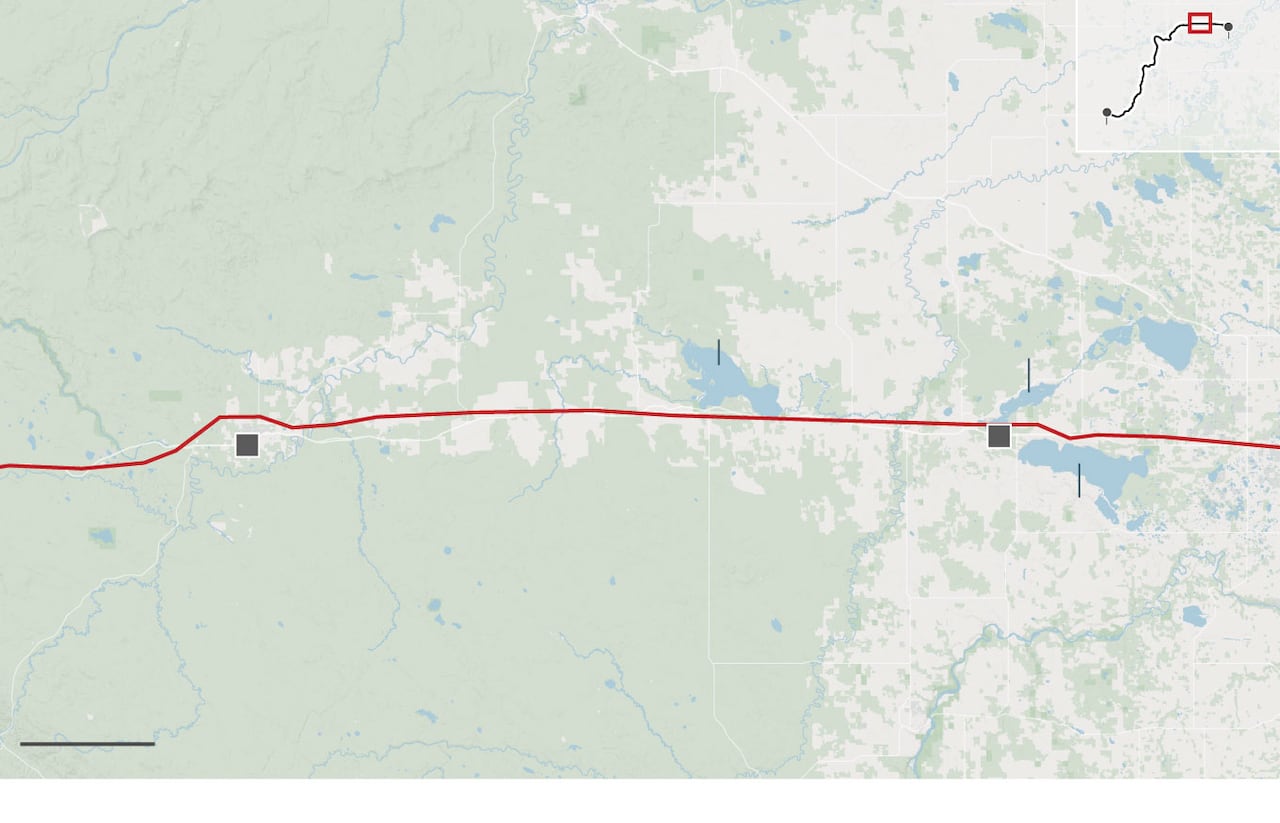
Buried underground, it is nearly invisible. The only real giveaways are the white and yellow signs dotting the landscape along the Yellowhead Highway west of Edmonton. Markers that someone could follow all the way to the Pacific Ocean, if they were determined enough.
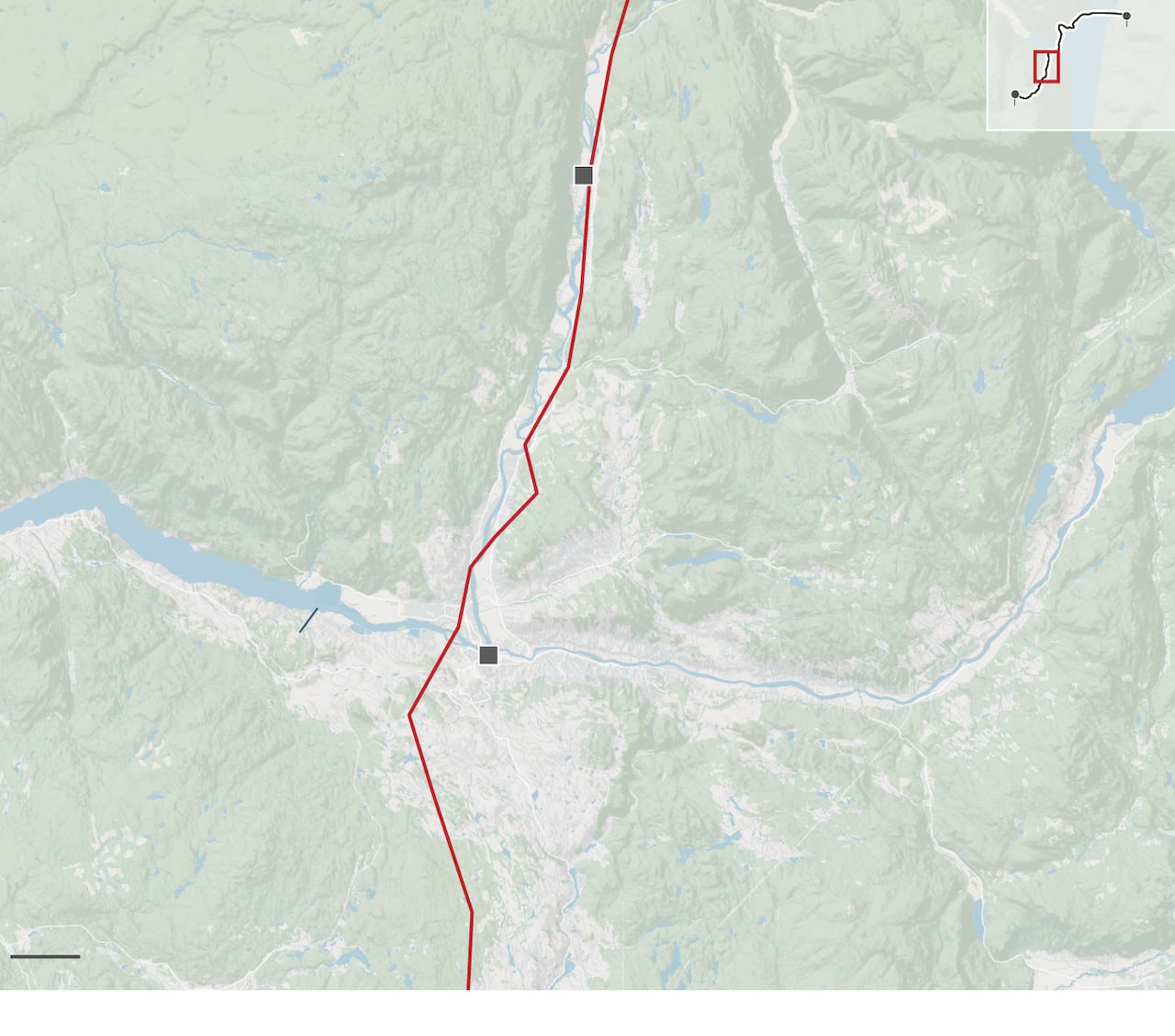
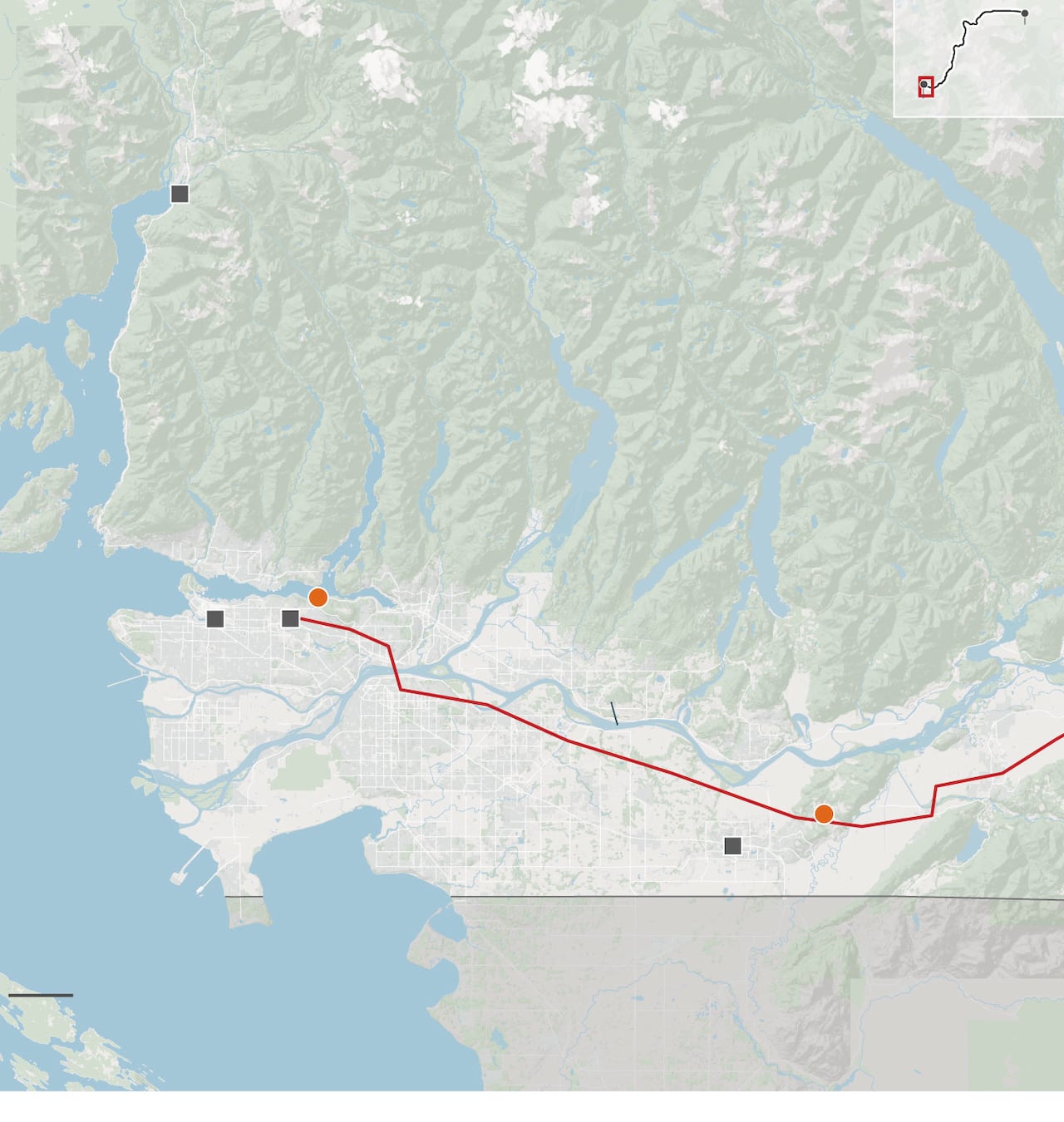
The Trans Mountain pipeline runs about 1,000 kilometres from Edmonton to Burnaby, B.C. Along the way, it passes through communities big and small and crosses the territories of dozens of First Nations.
When the valves open and the oil starts flowing Wednesday, the newly twinned Trans Mountain pipeline will carry nearly 900,000 barrels of bitumen from producers in Alberta to tanker ships on the coast each and every day.
Originally proposed by then-owner Kinder Morgan in 2013 and approved by the National Energy Board three years later, the expansion was nearly killed by legal challenges from the B.C. government, the City of Burnaby and environmental groups. By 2018, Kinder Morgan was ready to pull the plug on the project. That’s when the federal government intervened and bought the entire pipeline, with plans to build the expansion and then turn around and sell it.
Since then, the cost has skyrocketed, growing from the original estimate of $7.4 billion in 2017 to more than $34 billion in 2024. Trans Mountain blames the overruns on “extraordinary” factors like the pandemic, extreme weather and evolving compliance requirements.
As the project dragged on, so did the rallies and protests for and against it.
Rallying cries of “no means no” echoed across crowds of protesters in Burnaby carrying signs warning of climate change, risks to watersheds and insufficient Indigenous consultation. In Alberta, calls for economic development were backed by blaring truck horns and chants of “build the pipe.”
Trans Mountain workers put the finishing touches on the pipeline expansion on April 3 in Blue River, B.C. ( Josh McLean/CBC)
At a global energy conference in Houston in March, Trans Mountain’s chief financial officer, Mark Maki, said that the Trans Mountain expansion matters for Canada, and that the increased export capacity will mean better prices for oil producers, more jobs for Canadians and higher tax revenue.
“Employees with Trans Mountain, and I’m one of them, we’re happy,” said Maki. ”We’re getting to the end and that’s a reason to be proud. We’re doing something that, I think, is good for the country.”
While the shovels are being stowed away and work camps disbanded, a new reality persists for people who live and work with Trans Mountain beneath their feet, regardless of how they feel about the project.
Gainford, Alta.
Signs hang on the gate of the Trans Mountain Pump Station near Gainford, Alta. (Josh McLean/CBC)
About 90 kilometres west of Edmonton is the community of Gainford.
Bordered on the north by the picturesque Isle Lake and home to just 118 people, the hamlet is a blink-and-you’ll-miss-it kind of place.
It’s also host to a Trans Mountain pump station, which keeps up pressure in the pipeline and the oil flowing west.
Dawn Watts feeds chickens on her property in Gainford, Alta. (Josh McLean/CBC)
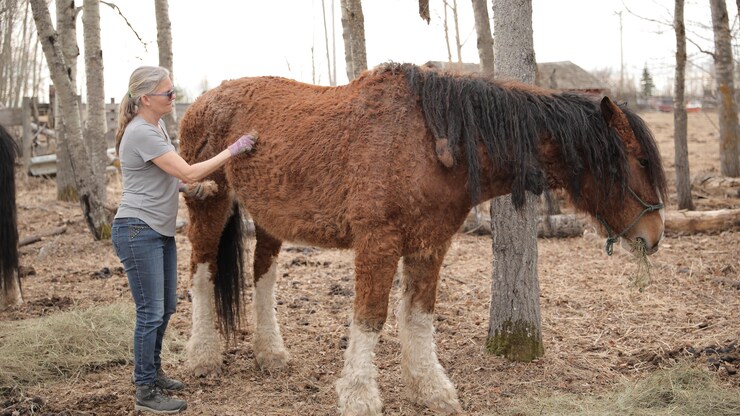
Dawn Watts grooms her horses and feeds her chickens a stone’s throw from that pump station. She owns Medieval Manor Gardens, a fledgling eco-tourism business that aims to connect people back to the land and nature with workshops and hiking tours. And to do that as sustainably as possible.
Still, Watts said there is a need for projects like Trans Mountain.
“We all have to eat. We have bills to pay. Most of us drive cars.” she said. “A lot of things rely on oil and gas still.”
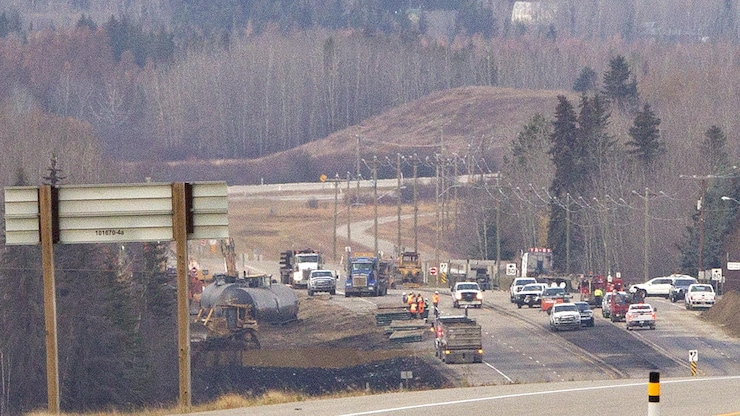
Watts also hopes the pipeline will be safer than the alternative: shipping oil by rail. Back in 2013, some tanker cars derailed across the highway from her property, creating an inferno so ferocious it melted the siding of the house where she now lives.
Crews clean up after oil cars derailed and exploded near Gainford, Alta., in October 2013. The home where Watts now lives is in the lower left. ( Dan Riedlhuber/Reuters)Heat damage remains on a house after oil cars derailed and exploded near Gainford in 2013. (ParklandCountyAB/YouTube)
But that doesn’t mean she doesn’t have concerns.
With a high water table and Isle Lake nearby, a leak or rupture could have devastating consequences. But she still thinks the pipeline is the safer bet.
“A pipeline break or something like that is unlikely to happen. You're probably more likely to get hit by a car crossing the road, so you’ve got to put it in perspective, right?”
Watts grooms one of her horses on her farm near Gainford. (Josh McLean/CBC)A cat crosses under a parked travel trailer at Medieval Manor Gardens. (Josh McLean/CBC)
At the end of the day, Watts sees Trans Mountain as a stepping stone towards a greener future as other energy sources become more practical. For her, it’s not a question of if clean energy becomes the norm, but when.
“There's other things, hydrogen and other alternatives coming. But this one pipeline is going to keep us going, I would imagine, for quite some time until these other alternatives can be put in place.”
Go a little further downstream on the pipeline and the question is: “What’s next?”
Edson, Alta.
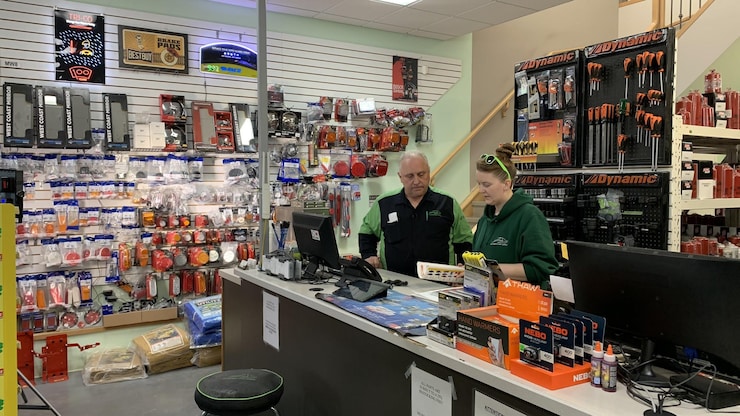
Patterson’s Part Supply in Edson, Alta. (Josh McLean/CBC)Don Patterson, left, chats with an employee in his parts shop. (Josh McLean/CBC)
A steady stream of customers filters in and out of Patterson’s Parts Supply in Edson. They chat and share a laugh with owner Don Patterson amid rows of gleaming wrenches and tubes of mechanical grease.
The oil industry has deep roots in this part of Canada.
“It has been a big part of our lives and it has meant a lot to our families and … to the past and to the future,” said Patterson.
A customer prepares to pay for his purchases at Patterson’s Parts Supply. (Josh McLean/CBC)
Even though Patterson wasn’t directly involved with Trans Mountain, he said the massive project was good news for his store. He saw an uptick of about 30 per cent in sales when pipeline crews were working in the Edson area. Other businesses saw a boost, too.
“Everybody was really connected to it. And it was a real boost for everybody's sales,” he said. “It was a positive effect, for the most part, on everybody in town. So it was really good to have.”
WATCH | An Edson business owner responds to pipeline critics:
Now that construction is wrapping up, that boom has faded. But Patterson remains optimistic about Edson’s economic future.
“There's a lot of projects that come,” he said.
“Whether it's mining, whether it's our power generation stations, there's always something that comes into our area or makes our area better.”
Whispering Pines, B.C.
As people in Edson look forward to the next big project, head toward the interior of British Columbia and there’s a feeling that Trans Mountain could be the future.
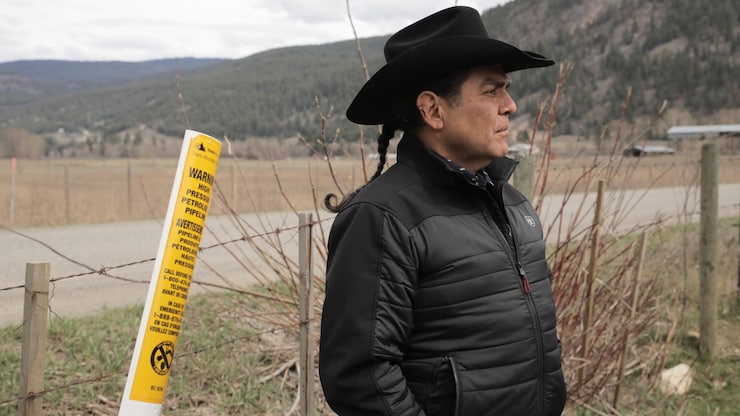
Mike LeBourdais stands near a marker for the Trans Mountain pipeline near his home on the territory of the Whispering Pines/Clinton Indian Band. (Josh McLean/CBC)
About 40 kilometres north of Kamloops, the pipeline has crossed the territory of the Whispering Pines/Clinton Indian Band for decades.
Mike LeBourdais thinks they should own a piece of it.
He’s part of the Western Indigenous Pipeline Group, an Indigenously owned company created by First Nations leaders who share that goal.
It has partnered with Calgary pipeline company Pembina to try to buy Trans Mountain. So far, about 40 other First Nations have signed on to the idea.
“We live with the risk, all day, every day since 1954 [when the original pipeline was built]. But we've never had the benefit,” he said. “Let us have the benefit for the next 70 years and see how that works for us.“
A warning sign marks the path of the pipeline in front of Trans Mountain pipeline facility on the territory of the Whispering Pines/Clinton Indian Band. (Josh McLean/CBC)
If the group’s proposal to buy the pipeline goes ahead, LeBourdais envisions First Nations using the revenue from owning the pipeline for everything from environmental protection to providing elder care.
“I think it is reconciliation,” he said. “It hasn't been done on this scale before.”
Robert Morin stands in front of the River Cree Resort & Casino on the Enoch Cree Nation west of Edmonton. (Josh McLean/CBC)
The Western Indigenous Pipeline Group is not the only Indigenous group looking to invest in the pipeline. Project Reconciliation, headquartered in Calgary, has its own proposal.
Chairman Robert Morin says it is aiming for 100 per cent Indigenous ownership.
“Every First Nation has managed poverty since the signing of treaties and the establishment of this country. That has to change,” said Morin.
WATCH | Indigenous pipeline ownership as way of reconciliation:
Kamloops, B.C.
Other Indigenous people are opposed to the idea of Indigenous ownership.
They think the environmental risk outweighs any economic benefits the pipeline might bring.
WATCH | An Indigenous woman cuts her hair to protest Trans Mountain:
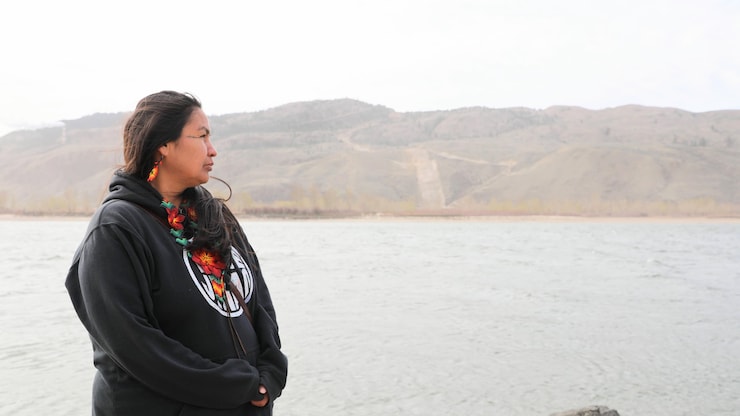
Miranda Dick fought hard against the construction of the Trans Mountain expansion. In 2020, she cut her hair outside a Trans Mountain construction site where the pipeline runs under the Thomson River, an outward display of grief and loss.
The Secwépemc matriarch and mother of six was arrested and charged with criminal contempt. Dick was found guilty and sentenced to 28 days in jail. But she has no regrets and plans to keep fighting.
Her big concern: The impact a break in the pipeline could have on waterways in her nation’s territory. She said not enough consultation was done to protect her people’s way of life.
Miranda Dick looks out over the water where the Trans Mountain pipeline crosses underneath the Thomson River in Kamloops, B.C. (Josh McLean/CBC)
“This is a short-term gain for long-term harm that could happen to our people,” she said.
Sumas First Nation
Further down the line in Abbotsford, the Sumas First Nation has experienced Dick’s concerns first-hand.
Trans Mountain operates a tank farm on Sumas traditional territory.
Chief Dalton Silver said there have been four spills over the past two decades. He worries the expanded pipeline will cause even more problems.
A worker responds to an oil spill at Trans Mountain’s Sumas terminal in Abbotsford, B.C., on June 14, 2020. (Darryl Dyck/The Canadian Press)
“There is something coming here that poses a big threat to the natural environment of our people and really could affect the livability of our homelands,” he said. “Of course I am opposed.”
Still, Silver said he understands the economic draw the pipeline represents for the First Nations along its route.
“There are a lot of communities that are, you could say, hard up for funds,” he said. “They're looking for opportunities to try and generate some of their own revenue. The opportunity came up and I don't blame them.”
Chief Dalton Silver stands in front of the Trans Mountain facility on traditional territory of the Sumas First Nation. (Josh McLean/CBC)
The Sumas First Nation waited longer than many other First Nations, but ultimately did sign a benefit agreement with Trans Mountain.
It’s something Silver said he was personally against, but the majority of community members wanted. His position has not changed now that other First Nations are showing interest in buying the pipeline.
“Those guys are my good buddies, my bros, and they know I have opposing views and they still approach me and wonder if I am interested,” he said.
“I have the old First Nation perspective that our obligation to our lands is to look after them.”
Burnaby, B.C.
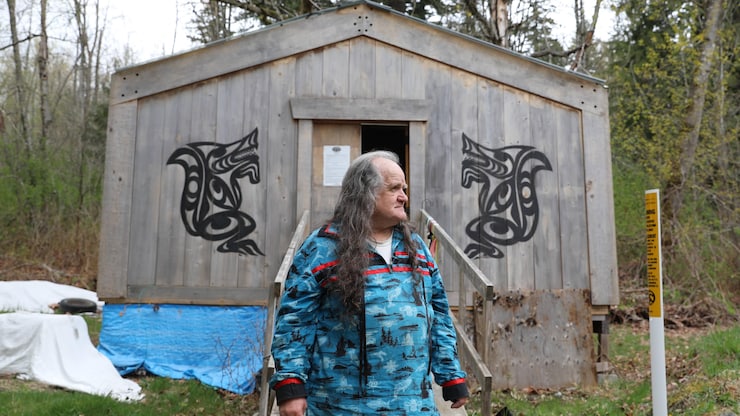
Further down the line in Burnaby, a small cedar building stands in the shadow of Trans Mountain’s massive tank farm.
Known as a watch house, it was constructed by members of the Tsleil-Waututh First Nation.
Such structures were traditionally used to keep a lookout for invading boats on British Columbia’s coastal inlets.
Today it watches over construction work at the expanding oil facility.
Jim Leyden stands in front of a traditional Tsleil-Waututh Watch House near the Trans Mountain terminal in Burnaby. (Josh McLean/CBC)A drawing of an orca hangs on the wall of the watch house in Burnaby. (Josh McLean/CBC)
“We will be here fighting this as long as we have to be here fighting it,” said Jim Leyden, the elder who cares for the watch house.
He’s not alone in that sentiment in Burnaby. Construction may be nearly finished on the Trans Mountain expansion, but many people in this coastal city are not ready to give up their opposition yet. For them, the threat of an incident is too real and the consequences too serious to back down.
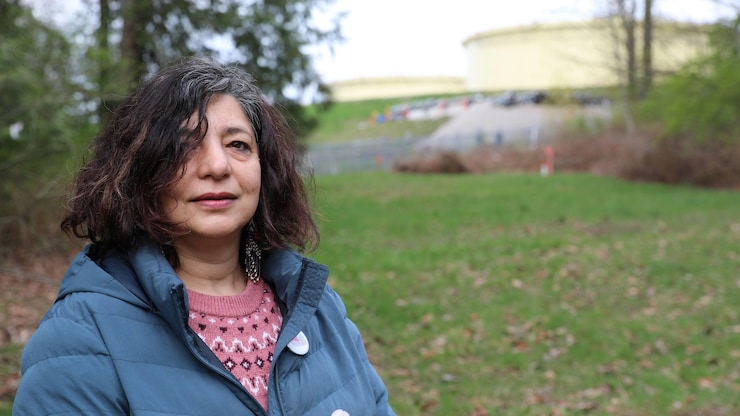
Tara Shushtarian lives next door to the tank farm, not far from the watch house, in an area she calls the “incineration zone.” Now there are more tanks and they’re bigger, and Shushtarian worries that if something happens she won’t be able to evacuate with her husband in time.
“Maybe in a couple of years … we'll have to think of moving out, because it's just too unsafe. We'll be much older. We won’t be able to run if there's an incident,” she said.
Burnaby resident Tara Shustarian stands near the Trans Mountain terminal near her home. (Josh McLean/CBC)
To try to address concerns for people like Sushtarian, Trans Mountain has detailed emergency and evacuation plans for the tank farm publicly available on its website.
The company points to its safety record and says it has never had a storage tank fire since it started operating the original line in 1953.
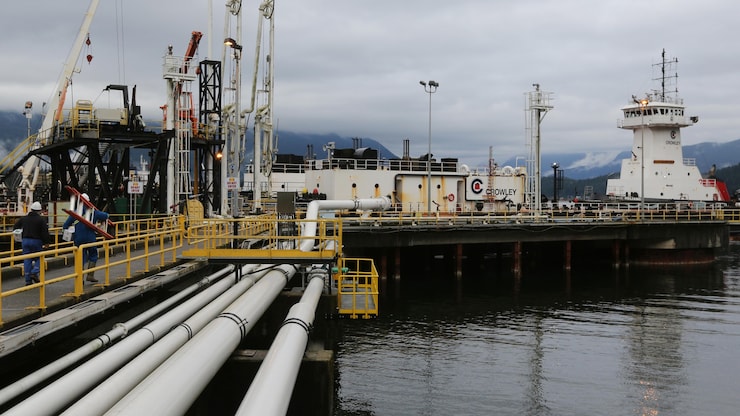
The Trans Mountain pipeline ends at Westridge Marine Terminal in Burrard Inlet, where oil is loaded onto tankers. The expansion means more oil flowing to the terminal and more tankers in the inlet — up from around five to as many as 34 each month.
For marine scientists, that means more risk.
Ocean pollution researcher Peter Ross stands on the shore of Burrard Inlet across from Trans Mountain’s Westridge Marine Terminal. (Josh McLean/CBC) (Josh McLean/CBC)
“Any spill would be catastrophic. A large spill would be absolutely cataclysmic,” said Peter Ross, senior scientist at the Raincoast Conservation Foundation.
It’s happened once before. In 2007, an excavator digging a trench for a new storm sewer ruptured the original line, spraying crude oil over nearby homes and forcing 250 people to evacuate. The oil flowed down into nearby Burrard Inlet, prompting a massive cleanup effort.
WATCH | An ocean pollution expert explains what an oil spill does to marine life:
But Ross said once the oil is in the water, it is difficult and dangerous to clean up and can have long-term consequences for sea life
A fisher casts a line in Burrard Inlet as a tanker is filled across the water in the Westridge Marine Terminal. (Josh McLean/CBC)
“The biggest concern is going to be around the effects on small developing fish and invertebrates, as they reproduce and as they try to grow in a soup that is very harmful to their health,” he said.
Dr. Tim Takaro passes a pamphlet to a passerby during a protest outside an RBC branch in Burnaby, B.C. (Josh McLean/CBC)
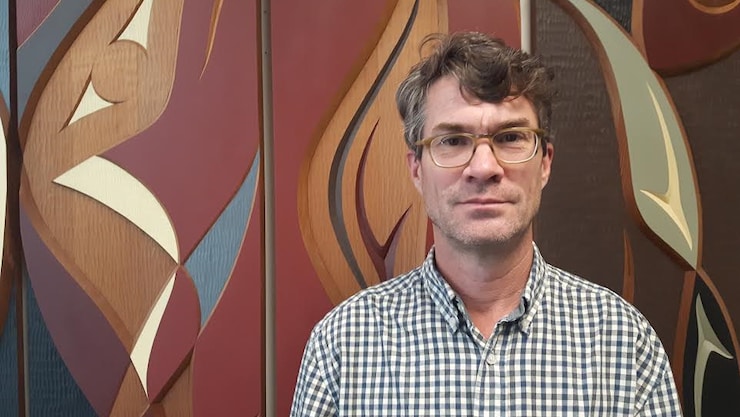
There are worries about climate change, too. Dr. Tim Takaro researched its impact on human health during his academic career at Simon Fraser University. These days, he can be found with other protesters in Burnaby outside a branch of RBC — a significant financier of fossil fuels in the world by some reports — urging customers to take their money elsewhere.
“This is about stopping the money pipeline,” said Takaro. “People do not understand the urgency of climate change and what is coming for us if we don’t turn off the spigot.”
Vancouver
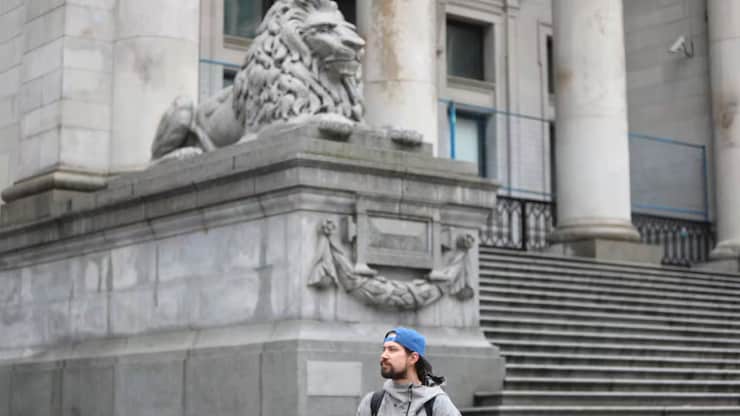
Mike McKenzie stands outside the Vancouver Art Gallery, which was the location of many protests against the Trans Mountain expansion. (Josh McLean/CBC)
Mike McKenzie remembers what it was like to protest the Trans Mountain expansion outside the Vancouver Art Gallery in 2022.
“Whenever I came here it was a big thing,” he said.
“It was like, whoa, there are a lot of people here. There is a lot of energy here.’”
For McKenzie, the completion of the Trans Mountain pipeline is a pivotal moment in his life. The Secwépemc knowledge keeper was not wholly opposed to the project.
Instead, he was fighting to “have [his] people honoured in the process.”
Now, he reflects on the more than 10 years he spent focused on the project — nearly one-third of his life.
He’s ready to move on.
McKenzie outside the Vancouver Art Gallery. (Josh McLean/CBC)
“I would definitely change my approach if I was protesting in the future,” he said.
“It was hard on me, it was hard on my family, it was hard on the people that I care about.”
McKenzie thinks there are lessons to be learned from Trans Mountain.
“I want people who are so on one side or the other to remember that we are people, that we are in this together,” he said.
“I would like to see that people that are in those spaces give a little to each side because we are in this together, whether we are on the same side or not.”
Editing | Janet Davison
Clarification
A previous version of this story included a reference to a 2023 report identifying RBC as the No. 1 financier of fossil fuels in the world. After publication of that report, its authors updated their information regarding RBC with corrected data, and it was shown as No. 5.




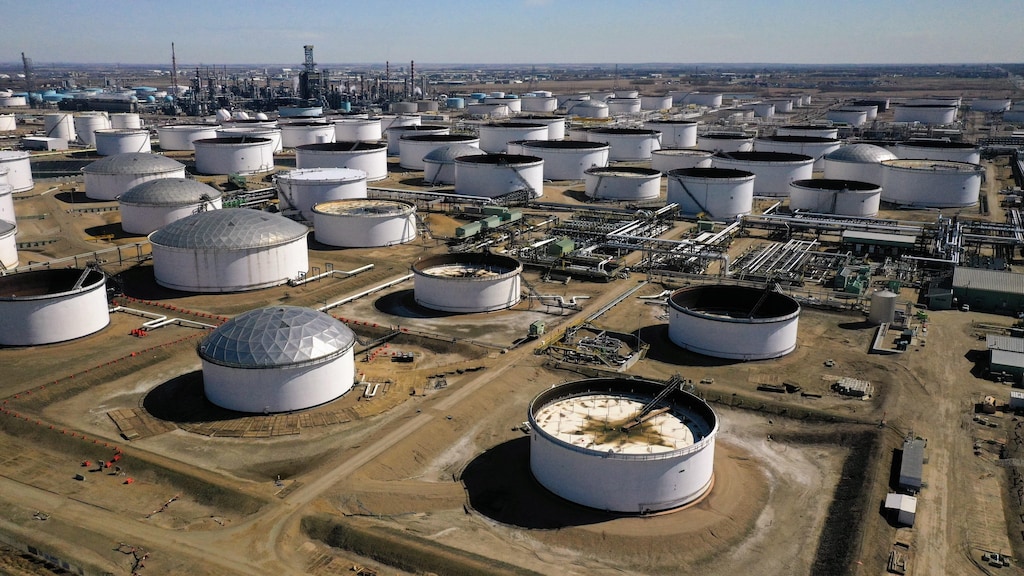 跨山輸油管道將艾省的焦油砂石油從埃德蒙頓的大型油庫運往卑詩省的本拿比。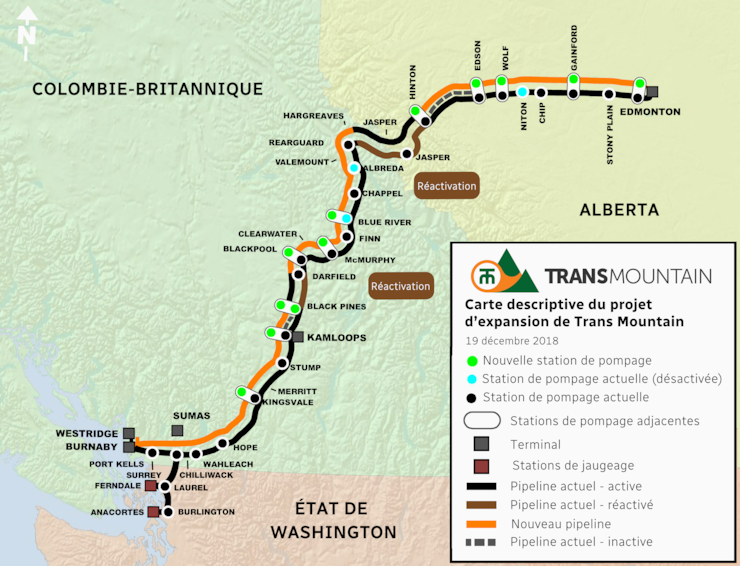







 POLITICS
 CALGARY
 BRITISH COLUMBIA