風蕭蕭_Frank
以文會友



宗教複興:伊斯蘭教、印度教和錫克教在加拿大蓬勃發展
過去二十年,移民對加拿大宗教構成的影響發生了變化
作者:薩南·伊斯蘭 2023年5月16日
https://broadview.org/canada-census-religion/
加拿大統計局最近的人口普查數據顯示,過去二十年裏,自稱穆斯林、印度教徒或錫克教徒的加拿大人口比例翻了一番以上,這主要歸功於移民。
2021年,穆斯林——僅次於基督教的第二大宗教群體——占加拿大約3700萬人口的4.9%,而2001年這一比例僅為2%。同期,印度教徒的比例從1%躍升至2.3%,錫克教徒的比例也從0.9%增長至2.1%。
2011年至2021年間宗教信仰的增長情況。
“這幾乎完全源於移民,以及移民群體中較高的生育率,”滑鐵盧大學副教授莎拉·威爾金斯-拉弗拉姆(Sarah Wilkins-Laflamme)說道,她的研究方向是宗教認同的趨勢。
她補充說,隨著移民的增加,這些宗教信仰將繼續增長,尤其是在聯邦政府承諾到2025年每年接收約50萬新移民的情況下。按照目前的趨勢,預計未來許多移民將來自南亞國家(特別是印度),印度教、伊斯蘭教和錫克教在這些國家較為普遍。盡管如此,與自稱信奉基督教(1940萬人)和無宗教信仰(1260萬人)的人數相比,自稱信奉這三種宗教之一的人數仍然相對較低(340萬人)。
雖然其他世界宗教在加拿大發展壯大,但除東正教外,基督教在加拿大所有教派的信徒人數都呈下降趨勢。 “就東正教而言,我們正從來自東歐、希臘和俄羅斯的移民中獲益匪淺。展望未來,鑒於當前的地緣政治形勢,我們似乎將會接收,並且已經開始接收大量烏克蘭難民,”威爾金斯-拉弗拉姆說道。
宗教信仰的多元化將遍及加拿大各地,而不僅僅是在大城市。根據人口普查數據,大多數新移民仍然傾向於定居在多倫多、溫哥華和蒙特利爾。通常,移民選擇加拿大的主要城市中心是因為那裏有更多的工作機會、更好的基礎設施和服務,以及現有的社交網絡。然而,選擇在加拿大三大城市定居的新移民比例正在下降。約有4%的人選擇在較小的城市地區安家,另有3%的人選擇了農村地區。
“我認為高昂的生活成本正在迫使所有人離開熱門地區,包括移民,”威爾金斯-拉弗拉姆說道。 “在一些原本多元化程度不高的地區……過去一年裏,多元化程度確實有所提高,這是一個關鍵趨勢——人們正從大城市遷出。疫情也對此有所助益,因為有些人可以遠程辦公。”
莎伊拉·卡特一家對加拿大移民家庭的這種趨勢再熟悉不過了。這位48歲的第二代加拿大穆斯林說,她的父親最初在20世紀60年代末從東巴基斯坦(現孟加拉國)移民到多倫多,因為當時“大家都”都去了那裏。但在1981年,為了買房,他帶著日益壯大的家庭搬到了安大略省的布蘭普頓——當時那裏還是個以基督教徒為主的小鎮。
布蘭普頓當時沒有清真寺,所以他們會開車去多倫多慶祝開齋節。“然後突然之間,我想大概在90年代,移民湧入了一大批人,”卡特說。“我們開始看到很多穆斯林和錫克教徒。”
更多Broadview的人口普查報道:
為何超過三分之一的加拿大人聲稱自己沒有宗教信仰
聯合教會的信徒人數下降幅度超過其他任何教派
布蘭普頓逐漸發展壯大,擁有眾多宗教場所、宗教學校以及服務於數萬南亞移民的各項服務。對於卡特的父母來說,隨著他們宗教信仰的日益虔誠,這種發展尤為重要。
五年前,高昂的房價迫使卡特和丈夫帶著家人從布蘭普頓搬到了安大略省的小鎮謝爾本。但三年後,卡特說,由於周圍穆斯林人數稀少,他們感到孤獨,於是想要離開——直到人口結構開始發生變化。
印度和巴基斯坦移民開始在該地區購買農田,第一座清真寺於2022年落成。“清真寺和宗教課程一開辦,我就開始感受到社區的歸屬感,”卡特說道。她也開始與非穆斯林鄰居分享自己的文化傳統。
並非每個人都能像卡特一樣找到歸屬感。令人遺憾的是,伊斯蘭恐懼症在加拿大日益抬頭。僅2021年一年,針對穆斯林的仇恨犯罪就增加了71%。魁北克省還在2019年通過了備受爭議的第21號法案,禁止了許多公共場所的宗教活動。
禁止企業員工在工作場所佩戴宗教標誌。一些人認為這項法律針對的是虔誠的穆斯林。
威爾金斯-拉弗拉姆表示,沒有足夠的數據支持穆斯林移民(其中許多人來自前法國殖民地)因為這項法律而避開魁北克的說法。“通常情況下,經濟因素,以及語言因素,更為重要,”她解釋道。
***
薩南·伊斯蘭是大多倫多地區的自由撰稿人。
本文最初發表於《博德維尤》2023年6月刊,標題為“宗教的興起”。
感謝閱讀
植根於信仰和正義的獨立新聞正麵臨威脅
《博德維尤》是加拿大唯一一家從包容、進步的基督教視角出發,提供深思熟慮、以價值觀為導向的新聞報道的媒體機構。但我們的工作依賴於您的支持。如果您珍視您剛剛閱讀的內容,請立即行動。
照片 今天的捐贈將幫助我們繼續報道新聞。
謹致謝意,
喬斯林·貝爾(編輯/出版人兼首席執行官)和特裏莎·艾略特(執行董事)
Religions on the rise: Islam, Hinduism and Sikhism are thriving in Canada
The proportion of people who report being Muslim, Hindu or Sikh in Canada has more than doubled in the last 20 years largely due to immigration, Statistics Canada’s recent census data shows.
In 2021, Muslims — the largest religious group after Christians — made up 4.9 percent of Canada’s population of roughly 37 million people compared to just two percent in 2001. During the same time period, the share of Hindus jumped to 2.3 percent from one percent, while the proportion of Sikhs grew to 2.1 percent from 0.9 percent.
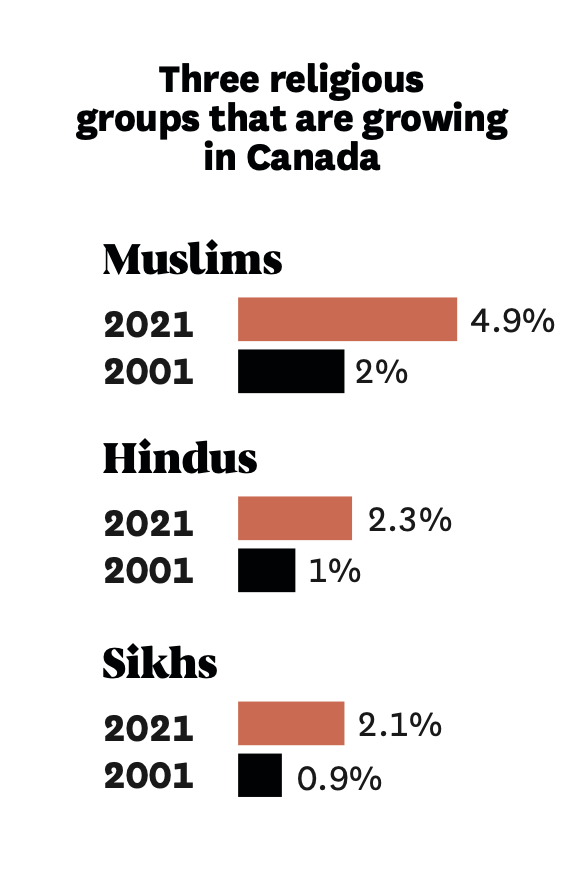 Growing religions between 2011 and 2021.
“It’s pretty much all coming from immigration, along with higher birth rates amongst immigrants,” says Sarah Wilkins-Laflamme, an associate professor at the University of Waterloo whose research explores trends in religious identities.
She adds that these religions will continue to grow along with immigration, especially with the federal government promising to accept about half a million newcomers every year through 2025. In keeping with current patterns, many future immigrants are expected to arrive from South Asian countries (particularly India), where Hinduism, Islam and Sikhism are common. Still, the overall number of people reporting affiliation to one of these three religions remains relatively low (3.4 million people) compared to those who report Christian affiliation (19.4 million) and no religious affiliation (12.6 million).
While other world religions are growing in Canada, Christianity is on a downward trend across all Canadian denominations, except Orthodox Christianity. “In the case of Orthodox Christianity, we’re gaining heavily from immigration from Eastern Europe, Greece and Russia. And moving forward, it looks like — because of the geopolitical situation currently — we’ll be accepting, and have already started accepting, a large number of Ukrainian refugees,” Wilkins-Laflamme says.
Religious affiliation will become more diverse across Canada, not just in big cities. Most newcomers still prefer to settle in Toronto, Vancouver and Montreal, according to census data. Typically, immigrants choose Canada’s major urban centres because there are more job opportunities, better infrastructure and services and existing social networks. However, the overall share of new immigrants who are settling in Canada’s three largest cities is declining. About four percent chose to make their homes in smaller urban areas, and three per cent chose rural areas instead.
“I think the high cost of living is pushing everyone out of hot spots, including immigrants,” says Wilkins-Laflamme. “In areas that haven’t necessarily seen much diversity … they’re definitely seeing more in the last year, so that’s a key trend — a move out of the big cities. But that was also helped by the pandemic since some people can do remote work.”
Shaila Carter’s family is all too familiar with these trends among immigrant families in Canada. The 48-year-old second-generation Canadian Muslim says her father initially immigrated to Toronto from East Pakistan (now Bangladesh) in the late 1960s because that was where “everyone” went. But in 1981, he moved their growing family northwest to Brampton, Ont. — a small, mainly Christian town at the time — to buy a home.
Brampton had no mosque then, so they would drive to Toronto to celebrate Eid. “And then all of a sudden, I think in the ’90s, there was this influx of immigration,” Carter says. “We just started seeing a lot of Muslims and Sikhs.”
More of Broadview’s census coverage:
Why over a third of Canadians now claim to have no religion
The United Church’s numbers have dropped more than any other denomination
Gradually, Brampton grew to offer numerous places of worship, faith-based schools and services catering to tens of thousands of South Asian immigrants. For Carter’s parents, this growth was important as they became increasingly religious.
Five years ago, the cost of housing also led Carter and her husband to move their family from Brampton to the small town of Shelburne, Ont. But three years in, she says they wanted to leave because they felt lonely with so few other Muslims around — until the demographics started changing.
Indian and Pakistani immigrants started buying farmland in the area, and the first mosque opened in 2022. “As soon as they started the mosque and [religious] lessons, I started feeling a [sense of] community,” Carter says. She has also begun to share her cultural traditions with her non-Muslim neighbours.
Not everyone finds belonging like Carter. Sadly, Islamophobia is on the rise in Canada. Hate crimes against Muslims increased by 71 percent in 2021 alone. The province of Quebec also passed the controversial Bill 21 in 2019, banning many public sector employees from wearing religious symbols in the workplace. Some feel this law is directed at observant Muslims.
Wilkins-Laflamme says there isn’t enough data to support the idea that Muslim immigrants, many of whom are emigrating from former French colonies, are avoiding Quebec because of it. “Usually the economic factors, and potentially the language factor, are more important,” she explains.
***
Sanam Islam is a freelance journalist in the Greater Toronto Area.
This story first appeared in Broadview’s June 2023 issue with the title, “Religion on the Rise.”
THANKS FOR READING
Independent journalism rooted in faith and justice is under threat
 A gift today helps keep this journalism alive tomorrow.
With gratitude,