A Wall Still Standing
By: Giorgio Provinciali
Live from Ukraine
Sloviansk — If a one-and-a-half-ton glide bomb rained down on any European city, Western media would likely cover it 24/7 for months. The Russian Air Force has dropped two bombs on the city we’re writing from in the last 48 hours, yet virtually no Western news outlet has even mentioned it. In other Donbas cities, such as nearby Kramatorsk, the rain of fire was so intense that it destroyed three multi-story buildings in the city center, while in Novodonetsk, a city packed with civilians, Russian bombs destroyed five yesterday. One bomb fell in Balakliia, at least two in Kharkiv, and three in Sumy.

We are in Sloviansk, in the heart of the Ukrainian Donbas that has resisted the Russian invaders for 12 years. This is the 1,522nd day since a terror resurfaced from the darkest bowels of history is attempting to engulf the entire country we live in.
A couple of hours’ flight from here, Italy is celebrating the definitive victory over an evil of the same origin. Yet this reality is not mentioned in any Italian newspaper, except for a few short articles composed remotely or by feeding artificial intelligence “news” culled here and there. Included those passed off as such by news agencies bent on the Russian regime, according to a strange concept of opinion-making now called “equal opportunity” in the country that made the Resistance one of the founding cornerstones of the Republic.

It’s April 25th in Ukraine, too. It’s snowing, and temperatures are well below zero. For the fifth year in a row, we want to remind it to those Italian “journalists” who denied the Bucha massacre in 2022, doubting that the corpses of the civilians we saw before us when the city was liberated could have preserved, while it was already warm in the “Bel Paese”.
None of them has ever apologized. Very few have ventured into forms of intermittent journalism more akin to war tourism, and overall, most of them seem to have even forgotten what happened in their homeland, 81 years ago.

Shortly before submitting this article, we received images of the house where we lived for a long time in Sumy. Since it was in the heart of the kill zone north of Kindrativka, only a drone could capture them. Of what was once a two-story house, only a single wall remains now standing. Sneaking his quadcopter into a hole under a blanket of spring snow, the drone operator who took those shots managed to float it through the tunnels that led from the garage to the cellars where we sheltered from Russian bombing for countless nights.
It’s not difficult to explain to Italians how that endless nightmare materialized: it would be enough to remind them of the incipit of “Bella Ciao”.
Yet, those who distance themselves from our Resistance by claiming that partisans and patriots like our grandparents experienced another one that ours is not up to are precisely those in Italy who call themselves their heirs.
The asymmetry of the Western gaze is no less damaging than Russian bombs.
Using tools of urban, psychological, and demographic demolition, the Russian Federation is not only striking military targets near what we once would have linearly defined as a “front”. It is turning civilian areas into constant targets. It is emptying those cities it cannot conquer. It is transforming the human map of areas like Sumy or Donbas, where we live, into a geography of rubble.
From these gray zones incompatible with life, we do not simply say to our friends and compatriots in Italy, “we too are resisting”.
The torture, summary executions, forced disappearances, and other crimes we have documented over the past 1,522 days are no longer a matter of opinion. Global institutions such as Human Rights Watch and OHCHR have reconstructed many of those terrible events that Italian deniers have justified in recent years with “alternative opinions”.
The problem isn’t understanding Ukraine.
The images we record and the texts we write are memories that pass through destroyed physical places.
The problem is that part of Italy recognizes the Resistance only after it’s already over, sanctified, risk-free, and incapable of disturbing the present. The Ukrainian Resistance, however, is alive, armed, mud-stained, and riddled with human errors, like all real resistances.
For this reason, it is perhaps even understood, but often rejected by those who prefer the black-and-white image of a partisan to the vivid one of a civilian under the bombs.

This creates a moral disproportion that intertwines the misalignment between the resistance rhetoric on the anniversary of the Liberation and the refusal to recognize the ongoing Ukrainian Resistance.
Our home in Sumy is reduced to a single wall, yet what holds it up, preventing the invaders from crossing it, is the same strength that flows through those who refuse to accept the normalization of violence and abuse. Everywhere in the world, it is part of the identity of all peoples.
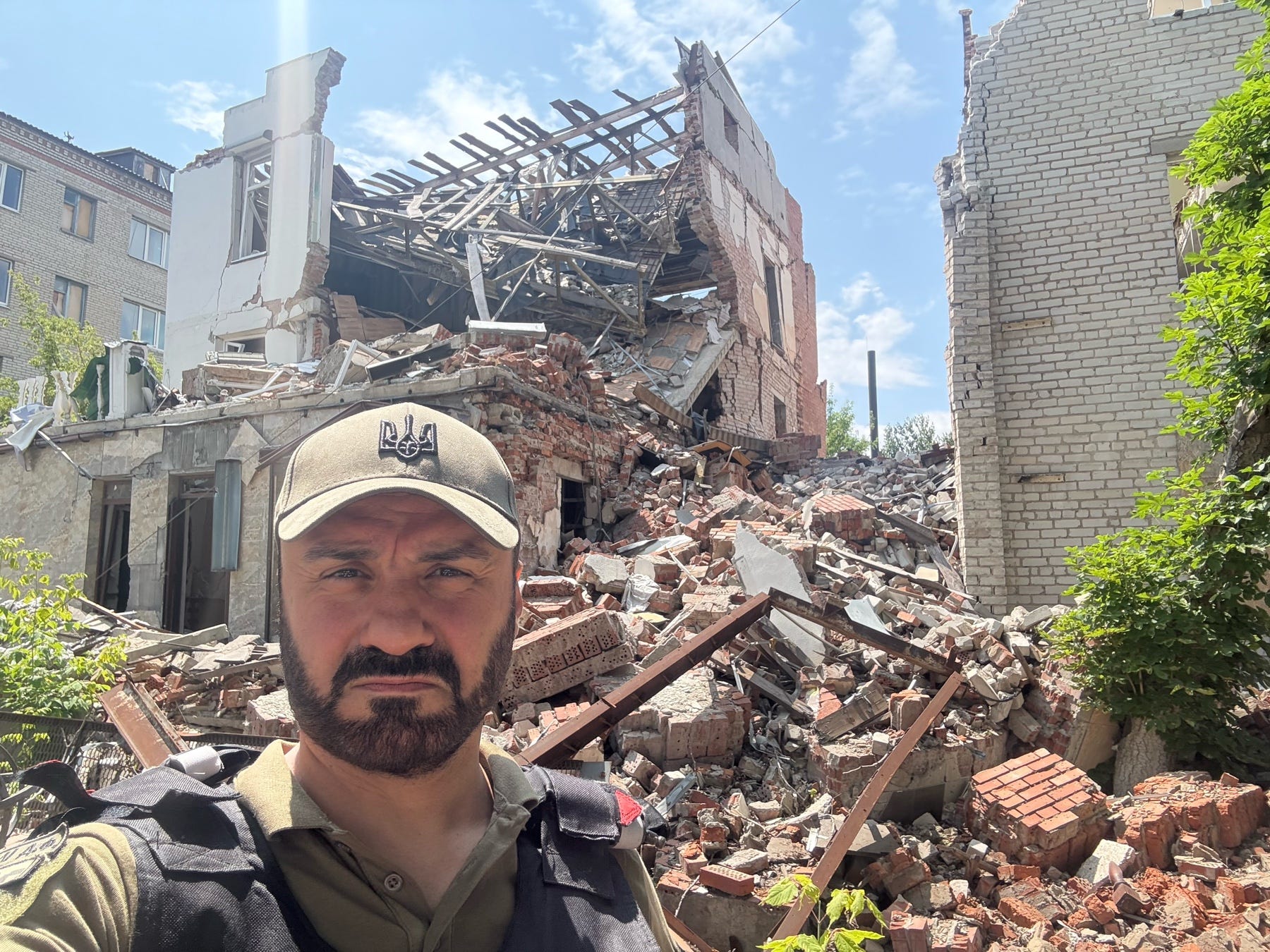
The tons of explosives the Russian regime is pouring on the areas of Donbas where we live today may erode the concrete, but not its strength.
However, the enormous disparity between the media coverage given to similar attacks in Western Europe and that reserved for cities like the one from which we write exacerbates the effects.
Carrying the torch of those who resisted 81 years ago cannot be done from afar. Despite all the flaws of those who write under real pressure, we will continue to report from places where very few choose to stay to ensure that that wall remains standing.

In 1.522 days of war, we recorded over 250 videos from ground zero and wrote more than 1,500 articles.
We are doing our best to provide genuine, first-hand reports from zones where almost no press dares to go. This means living in a kill zone constantly. We take the risk, but without your invaluable support, our voices would remain unheard and silent. Without brave people sharing our articles from afar, they would remain unread. Our reports would go unseen, and our efforts would be lost. There’s still a lot of work to do here, as the people around us are also in no better situation.
We’re renewing our fundraising campaign and thanking everyone who joins us in helping to restore what Russia is destroying. Moving forward with only a small reimbursement for each article from a brave newspaper that believes in us is extremely challenging. That’s why we are grateful to all the kind people who support us and trust in our mission.
Even a small donation helps.
We’ll keep you updated on developments.
Thank you all, dear friends
仍舊屹立的一麵牆
作者:Giorgio Provinciali
翻譯:旺財球球
烏克蘭前線報道
斯洛文斯克 —— 若一枚一噸半的滑翔炸彈落在任何一座歐洲城市,西方媒體很可能會全天候連續報道數月。過去48小時內,俄空軍在我們寫這篇報道的城市投下了兩枚炸彈,然而幾乎沒有任何一家西方新聞媒體提及此事。在頓巴斯的其他城市,如鄰近的克拉馬托爾斯克,火雨猛烈到摧毀了市中心三棟多層建築;在諾沃多涅茨克——一座人口密集的城市——昨日俄軍炸毀了五棟建築。巴拉克利亞有一枚落下,哈爾科夫至少兩枚,蘇梅三枚。
(圖:昨日一枚俄軍炸彈在烏克蘭斯洛文斯克市中心留下的彈坑)
我們身處斯洛文斯克,位於烏克蘭頓巴斯的心髒,這裏已抵抗俄羅斯侵略者達12年之久。自那股從曆史最黑暗深處再度浮現的恐怖試圖吞噬我們所居住的整個國家,至今已1,522天。
幾小時航程之外的意大利,正慶祝戰勝同源之惡的最終勝利。可沒有任何意大利報紙中提及我們所麵對的現實,除了為數不多的遠程撰寫、人工智能用零散“新聞”拚湊而成的簡短文章。其中還包括由親俄政權新聞社發布的所謂“新聞”,這在那個把抵抗運動作為共和國建國基石之一的國家裏,竟被稱為所謂的“機會均等”的一種奇怪的概念。
(圖:昨日俄軍炸彈落在烏克蘭斯洛文斯克市中心後留下的殘骸)
在烏克蘭,這裏也是4月25日。這裏正下著雪,氣溫遠低於零下。這已是連續第5年:我們要再次提醒那些意大利記者,他們在2022年否認布查大屠殺、質疑城市解放時我們親眼所見的平民屍體為何在“貝爾帕埃塞”(美麗國)已溫暖時仍能保存完好。
他們之中沒有一個人曾為此道歉。極少數人有過類似間歇性的、近乎戰地觀光的新聞報道;總體上,他們大多數人似乎已忘記81年前他們祖國發生的事。
(圖:我們在蘇梅長期居住的那棟房子,拍攝於本文撰寫當日)
就在提交本文前不久,我們收到蘇梅那棟我們曾長期居住的房子的影像。由於它位於金德拉蒂夫卡以北的殺戮區腹地,隻有無人機才能拍到。從曾經的兩層房子如今隻剩下一麵牆還屹立著。無人機操作者把四旋翼悄然穿過鋪著春雪的裂口,順著從車庫通向地窖的通道飛行,正是在那個地下室,我們無數個夜晚裏曾在那兒躲避俄方轟炸。
向意大利人解釋那場無盡噩夢如何成形並不難:隻需提醒他們《Bella Ciao》的開篇即可。
然而,正是那些聲稱像我們祖父母這樣的遊擊隊員與愛國者經曆了另一種抵抗,我們如今所經曆的不及那般偉大、從而與我們的抵抗保持距離的人,恰恰是意大利那些自稱為先輩繼承人的人們。
(視頻:我在烏克蘭哈爾科夫(烏克蘭第二大城市)拍攝的影像:三枚沙赫德/天竺葵無人機與另外三枚導彈擊中市中心一所有48名兒童的學校及其他民用設施 ——版權所有,Giorgio Provinciali)
西方視角的不對等性,其危害不亞於俄軍炸彈。
俄聯邦運用城市、心理與人口摧毀的工具,不僅打擊我們曾線性定義為“前線”附近的軍事目標,更將平民區變成持續的打擊對象。它在清空那些無法征服的城市,把我們生活著的像蘇梅或頓巴斯等地的人文地圖轉換為成一片廢墟的地理圖景。
在這些與生命不相容的灰色地帶,我們不隻是對意大利的朋友和同胞說一句:“我們也在抵抗”。
在過去1,522天裏我們記錄的酷刑、草率處決、強迫失蹤及其他罪行,已不再是意見問題。國際機構如人權觀察與聯合國人權事務高級專員辦事處已重構了其中許多可怖事件——近年中,意大利否認者卻以“另種觀點”為其辯解。
(視頻:我在烏克蘭巴拉克利亞拍攝的影像:俄軍無人機與導彈擊中市中心三棟擠滿平民的建築,造成屠殺——版權所有,Giorgio Provinciali
問題不在於是否理解烏克蘭。
我們記錄的影像與撰寫的文字,都是穿越被毀物理空間的記憶。
問題在於,意大利的一部分人隻在抵抗已成過去、被神聖化、無風險且無法威脅當下時,才認可那場抵抗。烏克蘭的抵抗則是活生生的、武裝的、滿身泥濘的,同時充斥著人的錯誤,正如所有真實的抵抗一樣。
因此,它可能被理解,但常常被那些更願意接受遊擊隊員黑白化形象而非一個在炸彈下的鮮活的平民現實的人所排斥。
(圖:Alla與我在烏克蘭頓涅茨克斯洛文斯克現場報道)
這造成了一種道德失衡,一方麵在解放紀念日時高喊抵抗話語,另一方麵卻拒絕承認正在發生的烏克蘭抵抗。
我們在蘇梅的家隻剩下一麵牆,但支撐它、阻止侵略者越過它的力量,正是那種那些拒絕接受暴力與虐待常態化之人的力量。在世界各地,這力量構成了所有民族身份的一部分。
(圖:Alla與我在烏克蘭頓涅茨克斯洛文斯克報道)
俄政權傾注在我們今日所居之頓巴斯地區的成噸炸藥,或許會摧毀混凝土,但摧毀不了這種力量。
然而,對類似襲擊在西歐與像我們所在城市之間所獲得的媒體關注之巨大差異,隻會加劇其影響。
傳承81年前那些抵抗者手中的火炬,無法從遠方完成。盡管在極大壓力下寫稿的人難免有缺陷,我們仍將繼續留在極少數人選擇駐守的地方報道,以確保那麵牆繼續屹立。
***
在1522天的戰爭中,我們從前線錄製了250多段視頻,並撰寫了1500多篇文章。
我們盡最大努力從幾乎沒有媒體敢進入的地帶進行真實的一手報道,這意味著我們長期生活在“殺傷區”。我們承擔風險,但若沒有你們寶貴的支持,我們的聲音將無從傳出。若沒有遠方的勇敢的人們轉發分享我們的文章,它們將無人問津。我們的報道會被忽視,我們的努力將付諸流水。這裏還有大量工作要做,周圍的人們境況同樣艱難。
我們正在更新籌款活動,感謝每一位加入我們、幫助修複俄羅斯破壞的人們。僅靠一家勇敢的報紙為我們每篇文章支付微薄稿酬以維持前線報道極為困難。因此,我們感激所有支持並信任我們使命的善良人們。
哪怕是小小的捐助也有助益。
我們會持續為你們更新事態進展。
謝謝大家,親愛的朋友們
如果你認可我們的工作,請支持我們
在過去三年裏,自烏克蘭大規模戰爭爆發以來,作為自由撰稿人,我們一直在烏克蘭戰爭的所有前線進行報道…
Paypal捐款鏈接:https://www.paypal.com/pools/c/9oqgW5u5oE
